
Decoding Hazardous Materials Classification
Identifying Dangerous Goods Regulations
Every year, misdeclared cargo causes delays, fines, and dangerous incidents. Decoding hazardous materials classification accurately is the first step in safe transport, and identifying dangerous goods regulations keeps every load lawful.
Start with the UN number and proper shipping name. They determine the packing group, transport category, and segregation needs. Dangerous goods regulations also require precise documentation and labelling for each class.
- Class 2 covers flammable gases
- Class 4 includes flammable solids
- Class 6 addresses toxic substances
An error here can shut down a warehouse or strand a vessel. That is why hazardous packaging & supply services pte ltd checks every classification before packaging is prepared, supporting compliance across South African trade routes.
The Globally Harmonized System (GHS) Pictograms
One glance at a label can stop a catastrophe. That is the quiet power of a GHS pictogram. The Globally Harmonized System gives hazard communication a visual shorthand that crosses every language barrier in South African ports and warehouses.
The symbols tell a worker what their senses cannot:
– the flame signals combustible materials
– the exclamation mark marks irritants
– the skull designates acute toxicity
Each pictogram demands a specific response. That response determines whether cargo moves safely or becomes an incident that halts operations. We at hazardous packaging & supply services pte ltd read these symbols before any packaging decision is made. This is where compliance becomes tangible.
GHS pictograms are not decoration. They are instructions rendered in colour and shape, and they save lives precisely because they are unambiguous.
Classes and Divisions of Hazardous Materials
Classification is where the abstract becomes operational. The United Nations splits dangerous goods into nine classes, and each class carries divisions that refine the risk. Explosives alone span six divisions, from mass explosion hazard to extremely insensitive articles. Gases split into flammable, non-flammable, and toxic. Flammable liquids sit in Class 3. These distinctions matter because packaging specifications change with every division.
The packing group, assigned alongside the division, dictates the strength of the containment. A substance that is merely corrosive needs different packaging than one that is spontaneously combustible. At hazardous packaging & supply services pte ltd, we match the UN specification to the precise class and division before anything moves. We do not guess. We read the classification and we pack to it.
Segregation and Compatibility Fundamentals
Two drums of nitric acid should never share a truck with a cylinder of flammable gas. That is segregation. Compatibility asks a different question: what can travel together without igniting, corroding, or reacting?
At hazardous packaging & supply services pte ltd, we treat the segregation table as a reference. The UN model regulations assign each class a compatibility group, and the packing group refines the risk further. The rules are precise:
– Oxidizers stay far from organics
– Acids never meet cyanides
– Flammables avoid any source of ignition
At hazardous packaging & supply services pte ltd, each combination demands its own containment. We cross-reference the segregation distance, the compatibility group, and the chemical properties before a single drum or IBC moves. That is how danger stays managed, not discovered. Never assume compatibility!
Regulatory Compliance and Legal Mandates
International Maritime Dangerous Goods (IMDG) Code
Nearly every consignment crossing the Atlantic or Indian Ocean must obey the International Maritime Dangerous Goods (IMDG) Code. This regulatory framework, crafted by the International Maritime Organization, turns abstract risk into concrete legal duties. For hazardous packaging & supply services pte ltd, that means every drum, every pallet, and every label carries the weight of enforceable mandates.
- Certified packaging must bear the UN marking.
- Transport information must match the dangerous goods manifest.
- Container packing certificates require a trained signatory.
South African authorities inspect these elements rigorously. A single discrepancy can halt an entire vessel. The IMDG Code also aligns with the Safety of Life at Sea (SOLAS) convention, making compliance a matter of survival, not paperwork.
Occupational Safety and Health Administration (OSHA) Standards
OSHA’s Hazard Communication Standard sits between routine work and catastrophe. Each year, thousands of workers suffer exposure to substances they never learned to handle. For hazardous packaging & supply services pte ltd, those statistics are unacceptable.
I have seen the cost of weak compliance. It appears in incident reports, insurance premiums, and legal claims. OSHA standards require chemical inventories to stay current, protective gear to match the hazard class, and every employee to read a Safety Data Sheet without hesitation.
- Workers verify container integrity before handling.
- Supervisors confirm SDS access within arm’s reach.
- Training records are reviewed without warning.
South African regulations align closely with the OSHA framework. Both demand relentless documentation. hazardous packaging & supply services pte ltd converts those mandates into daily discipline.
Environmental Protection Agency (EPA) Requirements
EPA requirements extend beyond the warehouse floor. They reach into the soil, the water, and the air around every facility. hazardous packaging & supply services pte ltd treats environmental compliance as a daily function, not an afterthought. In my experience, companies that treat EPA rules as paperwork are the ones that fail audits. hazardous packaging & supply services pte ltd builds those rules into its operational rhythm instead.
The EPA demands specific documentation for waste streams, emissions, and spill response plans. South African law follows the same logic through the National Environmental Management Act. Both systems require facilities to prove their processes before regulators arrive.
A practical compliance checklist covers several areas:
- Waste classification and manifest records
- Secondary containment inspections
- Emergency response procedures for chemical releases
- Air quality monitoring data
Each item carries legal weight. A missing signature or outdated permit can halt operations entirely. Companies that ignore these mandates face fines that exceed the cost of compliance many times over.
International Air Transport Association (IATA) Rules
Air travel leaves no room for guesswork. The International Air Transport Association, or IATA, sets the benchmark for moving dangerous goods by air, and hazardous packaging & supply services pte ltd treats these mandates as gospel. Every shipment needs precise labelling, approved packaging, and a declaration that passes strict scrutiny.
IATA rules change annually. Operators must track updates to packing instructions and limited quantity allowances. For example, lithium batteries demand specific state of charge limits. Missing one detail can ground an entire consignment.
- Shipper’s declaration forms must be accurate to the letter.
- Package markings require UN numbers and proper shipping names.
- Emergency response information accompanies every air waybill.
These legal mandates carry serious consequences. Noncompliance triggers fines and revocation of carrier privileges. Aligning procedures with IATA’s latest edition keeps air freight moving without costly delays.
Managing Safety Data Sheets (SDS) and Documentation
An incomplete safety data sheet can halt a chemical shipment before it leaves the warehouse. South African regulators treat SDS errors with the same gravity as physical breaches of handling rules. hazardous packaging & supply services pte ltd maintains documentation as a living record, not a static filing exercise.
The legal mandates carry real weight. Every SDS must capture chemical composition, physical hazards, handling protocols, and emergency response measures. One missing section invites audits, penalties, and operational paralysis.
Documentation discipline demands attention to the following:
- Verify each SDS against current supplier revisions.
- Archive superseded sheets for the legally required retention window.
- Cross-check UN numbers and packing groups before every dispatch.
Regulatory compliance lives in these details. Accurate paperwork moves freight through South African ports without friction. Sloppy records leave cargo lingering in warehouses and liabilities stacking up. hazardous packaging & supply services pte ltd treats every document as a sworn statement.
Packaging Standards and Material Selection
Understanding UN-Rated Packaging Certified Standards
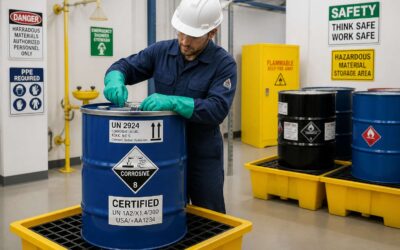
Every year, thousands of shipments fail because the packaging cannot withstand the journey. The UN-Rated packaging certification exists to prevent this. It is a rigorous system of performance testing that evaluates durability, stacking strength, and resistance to pressure changes. For hazardous packaging & supply services pte ltd, selecting the right materials begins with understanding these certified standards.
The material itself matters as much as the rating. Polyethylene drums handle many corrosive liquids, but they degrade with certain solvents. Steel containers offer strength, yet they react with acids. Fibreboard boxes are lightweight, but they absorb moisture. The UN marking on a package tells you the exact group, the packing group level, and the performance standard, but only if you match it to the chemical properties.
- Check the chemical compatibility chart.
- Verify the packing group (I, II, or III).
- Confirm the tested capacity and specific gravity.
South African exporters face extreme temperature shifts and long port delays. Certified packaging must survive these realities. That is why hazardous packaging & supply services pte ltd insists on reviewing the UN-Rated standards before any material selection. The certification is your guarantee, but the material choice is your responsibility.
Choosing Cushioning and Absorbent Materials
Cushioning and absorbent materials rarely earn attention until something leaks. A sudden fork lift jolt can shift a drum, and without proper absorbents, a small spill becomes a costly incident. I have watched shipments fail over a missing layer of padding.
For hazardous packaging & supply services pte ltd, selecting these materials requires observation. Polyurethane foam absorbs impact, while vermiculite and diatomaceous earth contain liquid spills. The material must match the chemical’s reactivity and physical demands.
Consider the following:
- Chemical compatibility with the cushioning medium.
- Absorption capacity under compression.
- Performance in South Africa’s humidity and heat.
Every layer adds a margin of safety. That is the craft of proper packaging.
Compatibility Testing and Chemical Resistance
Compatibility testing is where good intentions meet hard evidence. For hazardous packaging & supply services pte ltd, no cushioning choice is final until the chemical has proven it can coexist with the material under pressure. Chemical resistance cannot be assumed from a data sheet.
South African conditions add their own demands. Heat and humidity accelerate degradation, so a polymer that performs in a German lab may fail in Durban. Standards exist for a reason, but they only matter when applied honestly. A packaging specification must be tested, not estimated.
- Test for swelling, cracking, and loss of tensile strength.
- Expose samples to both the chemical and the environment.
- Verify results against the UN packaging standard.
Every test closes the distance between assumption and reality. That is how hazardous packaging & supply services pte ltd earns its reputation, one verified material at a time.
Tamper-Evident and Leak-Proof Sealing Technologies
Sealing a hazardous package is a measured act. The lid must meet its vessel. For hazardous packaging & supply services pte ltd, material selection begins with the seal itself. Not every polymer survives the torque of a screw closure.
Tamper-evident technologies have evolved beyond frangible bands. Consider induction foil liners that bond to the container mouth, or breakaway caps that leave a visible witness. Each option demands a specific coefficient of friction and thermal tolerance.
- Verify the seal’s compatibility with your container’s resin.
- Test the closure under vibration and temperature cycling.
- Confirm the leak-proof rating against the UN standard.
Leak-proof sealing is not an accessory. It separates a chemical from the world. For hazardous packaging & supply services pte ltd, a gasket that swells in humidity becomes a failure. A seal that hardens in cold becomes a hazard.
Labeling and Marking Essentials for Dangerous Goods
Packaging standards are not abstract ideals. They become tangible when a drum flexes under pressure. For hazardous packaging & supply services pte ltd, material selection begins with the container’s resin and its reaction to the product inside. High-density polyethylene resists many corrosives, yet it can crack under stress. Always verify the UN marking against the specific substance! Labeling and marking compounds the challenge. A hazard label peels off in a humid warehouse when the adhesive fails. Use inks that survive salt spray and UV exposure.
For dangerous goods, these essentials matter:
- The UN number and proper shipping name in permanent ink.
- Orientation arrows that remain visible after rotation.
- Consignor details legible under abrasion.
Each element must withstand vibration and temperature cycling. That is what separates compliant packaging from a liability. Hazardous packaging & supply services pte ltd knows this reality.
Supply Chain and Logistics Optimization
Temperature-Controlled Transport of Hazardous Materials
A single degree of temperature shift can compromise an entire batch of hazardous material. For hazardous packaging & supply services pte ltd, that reality shapes every logistical decision we make. We combine refrigerated vehicles with smart insulation systems, ensuring stable thermal conditions from our warehouse to your site.
Our route planners use live weather data and traffic patterns to shorten exposure windows. Sensors inside each container transmit readings every few minutes, allowing our team to react before problems escalate. This optimization cuts waste, protects workers, and keeps delivery schedules intact. We have also streamlined energy consumption through better airflow management. That kind of efficiency makes temperature controlled transport both safer and more affordable!
Specialized Storage and Dedicated Warehousing Sites
Efficiency does not end at the warehouse gate. For hazardous packaging & supply services pte ltd, supply chain and logistics optimization starts inside dedicated warehousing sites, where every pallet position is planned down to the metre.
Our storage strategy begins with segregation. Each product is assigned a bay based on chemical family, packing group, and movement frequency. High-turnover items sit closest to dispatch, while slow-moving stock remains in deep storage. That layout cuts forklift travel, reduces congestion, and shortens turnaround times across South Africa’s industrial hubs.
Warehouse teams use a live inventory platform that syncs with transport schedules. When a vehicle arrives, the correct pallet is already staged and checked. Daily routines include:
- Verifying seal integrity before release
- Monitoring temperature and humidity in every zone
- Rotating stock to meet expiry deadlines
This is specialised storage with a purpose. Materials stay stable, documentation stays accurate, and shipments leave on time. That discipline is what hazardous packaging & supply services pte ltd brings to every client’s supply chain.
Emergency Response Planning and Contingency Measures
An emergency is simply a delay that demands a plan. For hazardous packaging & supply services pte ltd, that plan starts before the first pallet moves. We map every plausible disruption, from a leaking drum to a closed border post, and assign concrete actions to named people.
Contingency measures include backup transport routes, pre-approved replacement packaging, and direct lines to emergency services in each South African province. Our teams run drills quarterly, not yearly, because rusty responses cost more than clean ones.
- Verify all response kits have fresh absorbents and seals
- Confirm driver contact lists match current shift rosters
- Test communication systems with a simulated incident
These steps keep recovery times short and documentation intact. When something does go sideways, the outcome is controlled, and your supply chain keeps moving.
Risk Assessment and Delivery Route Optimization
Every hour a hazardous load sits idle, the cost compounds. For hazardous packaging & supply services pte ltd, route optimization is a safety measure, not an afterthought. We analyze road conditions, border delays, and weather patterns before each dispatch, cutting transit time and driver fatigue.
Risk assessment follows the same logic. We grade each corridor by accident history and emergency response availability, then choose the safest path. That process often surprises clients who expect speed above all.
Consider our pre-trip checklist:
– Verify load compatibility with toll and weighbridge requirements
– Confirm rest stops have proper spill containment facilities
– Cross-check live traffic alerts for hazardous material restrictions
These checks keep your supply chain moving without breaking compliance. Hazardous packaging & supply services pte ltd builds resilience into every kilometre, so your cargo arrives on time and intact.
Last-Mile Delivery Challenges for Dangerous Goods
The final kilometre of a dangerous goods journey often feels like the longest. Residential roads, school zones and unexpected roadworks demand a different kind of vigilance. The last mile is where delivery windows compress and where public proximity becomes an unavoidable variable.
For hazardous packaging & supply services pte ltd, this stage requires granular planning. Each drop point is assessed for access constraints, parking restrictions and nearby sensitive sites. We also factor in the human element: drivers must often communicate with receivers who have no hazardous materials training.
- Time windows that force parking in congested areas
- Inadequate receiving points with no spill containment
- Unforeseen pedestrian and traffic congestion
Every one of these variables affects the safe arrival of your consignment.
Choosing a Trusted Hazardous Packaging Partner
Verifying Certifications and Industry Accreditations
Third-party certification is not decorative paperwork. It is the line between a compliant shipment and a serious incident at the port. When you evaluate hazardous packaging & supply services pte ltd, ask their quality manager which accreditation bodies audit them. Look beyond the logos on their website!
We dig into such records when selecting logistics partners in South Africa. The essentials include:
- UN-Rated certification documents
- Staff training and assessment logs
- Facility permits for DG storage
These must match actual work on the packaging line. A supplier who shows you their full audit trail earns your trust. That openness reveals a culture of discipline. And that is exactly what your dangerous goods require.
Custom Packaging Engineering and Prototype Testing
A single prototype failure discovered in the field costs twenty times more than one caught in the workshop. That math drives how we approach custom packaging engineering with hazardous packaging & supply services pte ltd.
Choosing a trusted partner starts with understanding how your cargo behaves in transit. Dimensions, weight, and handling conditions all differ. Off the shelf boxes rarely match. We engineer packaging around the product’s real requirements, accounting for the specific journey it must survive across South African roads and through ports like Durban.
Prototype testing is where the design proves its worth. We drop, crush, vibrate, and weather each unit under anticipated conditions, document the results, then refine. The cycle follows a sequence:
- Define cargo parameters and transport modes.
- Engineer a prototype using certified materials.
- Run physical tests and record failures.
- Refine the design and retest.
- Sign off on the final unit for production.
Watch how a supplier responds to a failed test. A disciplined team treats failure as data, not a setback. That response tells you everything about their culture and their ability to protect your dangerous goods.
Reviewing Track Records and Sector-Specific Expertise
Track records reveal more than a company’s age. They show how a partner handled the unpleasant surprises that inevitably arrive with dangerous goods. When we evaluate suppliers, we look for evidence of sector-specific expertise, not generic promises. A mining client in Mpumalanga has different needs than a pharmaceutical distributor in Cape Town. The packaging that suits one may fail the other.
Ask any candidate about their history with hazardous packaging & supply services pte ltd. The good ones will show you case studies, incident reports, and client references. The mediocre ones will show you brochures. We look for proof of real-world adaptation across sectors:
- Chemical manufacturers with corrosive liquids and reactive solids
- Agriculture exporters moving fumigated consignments through Durban
- Petrochemical plants with high-temperature logistics chains
Relevant experience matters because regulations shift and a wrong packaging choice creates delays, fines, and worse. Hazardous packaging & supply services pte ltd earns trust through documented failures and fixes, not polished marketing materials.
Value-Added Services: Labeling, Crating, and Inspection
Labeling, crating, and inspection seem minor until a consignment fails a port audit. A trusted partner like hazardous packaging & supply services pte ltd treats these functions as essential compliance work. The value of a partner shows in such small details.
Proper labeling means more than legible text. It means correct placement, weather-resistant materials, and alignment with current regulations. Crating protects packaging from the journey, especially for exports leaving Durban or Cape Town, where handling is rough and humidity unforgiving.
Inspection completes the cycle. Every drum, box, or intermediate bulk container deserves a documented check before departure. Hazardous packaging & supply services pte ltd makes this non-negotiable. Our teams verify:
- Container integrity
- Label placement and legibility
- Seal and tamper evidence
- Documentation matching the consignment
Shipments have been delayed for days over a missing arrow label or an improperly secured pallet. These details decide whether your cargo moves or sits.
Assessing Cost-Efficiency, Scalability, and Turnaround Time
Choose a partner for more than price. Hazardous packaging & supply services pte ltd bases its cost model on the full journey, not the initial quote. We have seen cheaper crates fail port audits in Durban, and the detention fees erase any savings.
Scalability matters just as much. Seasonal peaks and emergency consignments need a partner who can expand capacity without compromising compliance. Turnaround time matters equally. When a vessel sails in 48 hours, the packaging must be ready! Verify the ability of hazardous packaging & supply services pte ltd to deliver under pressure before you sign.
Consider these points:
– Cost transparency across materials, labour, and transport
– Capacity to absorb volume spikes without compromising compliance
– Realistic turnaround promises with documented delivery times


0 Comments