
Regulatory Landscape for Liquid Hazardous Materials
Identifying Hazard Classes and Packing Groups
In South Africa, the regulatory landscape for liquid hazardous materials is both specific and unforgiving. Knowing when packaging liquid hazardous materials demands proper classification, the SANS 10228 and the National Road Traffic Act set the ground rules. Ignore the packing group and your warehouse becomes a mess.
Classifying a liquid involves matching its flashpoint and boiling point to a UN class, from Class 3 flammables to Class 8 corrosives. Then you assign a packing group based on the severity of that danger. The scale runs like this:
- Packing Group I: High danger, a spill means immediate evacuation.
- Packing Group II: Medium danger, the everyday industrial hazard.
- Packing Group III: Low danger, but still a headache if you ignore it.
These assignments are non-negotiable when packaging liquid hazardous materials. They dictate the drum type and the UN certification. Get it wrong and you face fines.
UN Numbers and Proper Shipping Names
A single misdigit on a UN number can stall a truck for days. Every liquid moving through South Africa carries a four digit identity and a proper shipping name. These are not suggestions. Every transport document must include them. When packaging liquid hazardous materials, the UN number must appear on the packaging, the consignment note, and the vehicle signage. The proper shipping name tells officials what is inside. This matters at every checkpoint, from Durban harbour to a remote weighbridge.
Consider how the system works. The UN number directs emergency responders to the correct procedure. The proper shipping name removes ambiguity. For example:
- UN 1203 is petrol, not fuel
- UN 1789 is hydrochloric acid, not cleaning solution
- UN 1263 is paint, not industrial coating
Those distinctions affect spill management, personal protective equipment, and insurance liability. Get them wrong and the load becomes a hazard before the cap is ever opened.
Compliance with DOT, IATA, and IMO Regulations
The regulatory landscape for moving dangerous liquids is a triptych of international codes. Road transport follows DOT guidelines. Air freight falls under IATA. Sea shipments answer to the IMO. Each regime carries its own marking, labelling, and documentation demands. When packaging liquid hazardous materials, you must satisfy all three standards at once, because a consignment often changes mode mid-journey.
- DOT focuses on vehicle placarding and driver certification.
- IATA restricts container volumes and demands specific packaging performance tests.
- The IMO’s IMDG Code dictates segregation and stowage aboard vessels.
IATA’s rules are the strictest. They limit quantities, specify container types, and prohibit certain chemicals outright. The IMO adds segregation requirements that shift with the vessel’s route. DOT regulations emphasise driver training and emergency response information.
This layered compliance is not optional. An inspector at OR Tambo or Cape Town Container Terminal will check every package against the relevant code. Mismatches between modes can strand cargo for weeks. I find that shippers often underestimate how deeply these frameworks diverge.
Exceptions and Limited Quantity Rules
Not every drum and intermediate bulk container needs the full regulatory apparatus. Exceptions exist for small consignments. Limited quantity rules allow modest inner packagings to travel under reduced paperwork, provided the outer box stays under the gross mass threshold. Air freight imposes the tightest limits. Road transport allows more room.
When packaging liquid hazardous materials under limited quantity rules, the focus shifts to simple marks:
- The LQ diamond with the UN number.
- Inner packaging volume limits per vessel.
- An outer carton holding a maximum gross mass of 30 kilograms.
No placards. No elaborate segregation plans. When packaging liquid hazardous materials, exceptions replace documentation with precision. South African shippers must still reconcile SANS 10233 with the international codes. Check the limits twice. I have seen one overfilled bottle invalidate an entire consignment. The exception is a contract with specific terms. Break them, and your cargo sits at Durban Container Terminal while customs takes a closer look.
Selecting Packaging That Meets Safety Standards
Comparing UN-Certified and Non-Certified Containers
A single compromised container can shut down an entire warehouse. That risk becomes acute when packaging liquid hazardous materials, where the choice between UN-certified and non-certified containers defines your legal exposure. UN-certified units have survived standardized drop and pressure tests. Non-certified units offer no such evidence. They may hold liquid today, but they lack a verified track record under transport stress.
Certified packaging also simplifies cross-border movement. Customs officials in South Africa and elsewhere expect valid UN markings. Without them, your shipment can be held for inspection or returned.
Key distinctions:
- UN certification ties the container to a specific design type.
- Test results are documented and traceable.
The non-certified path saves money upfront yet risks far more in the event of an incident.
Material Compatibility with Aggressive Liquids
The liquid itself poses the greatest threat. When packaging liquid hazardous materials, the container must survive its own contents. A drum that holds water without issue may soften, swell, or perforate when filled with concentrated acids, oxidisers, or chlorinated solvents. UN certification proves structural integrity, but it does not guarantee chemical resistance.
Material compatibility is a separate discipline. Three factors demand attention:
– Permeation, where vapours migrate through the container wall
– Stress cracking, triggered by chemical attack on polymer surfaces
– Thermal acceleration, where heat speeds up degradation
High-density polyethylene resists many aggressive liquids, yet certain hydrocarbons cause it to swell and lose strength. Steel drums handle solvents but corrode rapidly in acidic environments. Fluorinated packaging offers an alternative for severe applications.
Review the manufacturer’s compatibility chart before every selection. Skip this step, and a containment failure becomes probable.
Rigid IBCs, Drums, and Jerricans: Pros and Cons
Choosing the wrong container can turn a routine shipment into a crisis. When packaging liquid hazardous materials, the container is the final barrier between your cargo and a potential environmental catastrophe. Each option, from rigid IBCs to drums and jerricans, offers a distinct trade-off between cost, durability, and handling.
– Rigid IBCs hold up to 1,250 litres, reducing handling time, yet they require forklift access and dedicated storage space.
– Steel drums provide robust puncture resistance, though they add significant weight to the shipment.
– Plastic jerricans are lightweight and cost effective, but they offer limited protection against physical impact.
The choice depends on the chemical’s specific gravity and the transport mode. A 200-litre drum suits road freight, while an IBC may overwhelm a small warehouse. The container’s discharge valve also introduces leak points that a sealed drum simply does not have. Review the UN markings and the manufacturer’s data sheet, then verify the container’s capacity against the liquid’s fill ratio. The safest option is not always the most expensive, but it is always the one that matches the chemical, the distance, and the destination.
Pressure Ratings, Vapor Management, and Permeation
Pressure builds silently inside every sealed container. When packaging liquid hazardous materials, the packaging must withstand the vapour pressure that rises with ambient heat. A container rated for moderate climates may fail on a Namaqualand summer day! Permeation is quieter still; vapours migrate through polymer walls molecule by molecule, leaving the drum intact while the cargo slowly escapes. Selecting a closure system and headspace becomes an exercise in vapour management.
Consider these factors before choosing packaging:
– Pressure rating versus the highest expected transport temperature.
– Permeation rate for the specific chemical, not a class of chemicals.
– Vapour that may condense and corrode fittings.
The UN marking offers only a baseline. Pressure, vapour, and time will reveal what the certificate cannot.
Performance Testing and Certification Markings
Certification markings are often misread as a verdict of quality. They are a record of performance testing under specified conditions. When packaging liquid hazardous materials, a UN mark indicates that a sample survived specific tests:
- Drop test at a set height.
- Stack test under load.
- Leakproofness test for liquids.
The certificate does not guarantee that every drum in the batch behaves identically. Manufacturing variance, closure torque, and liner integrity shift the result. The mark is valid only for the exact specification. Check the test report for batch numbers and production dates. A mark from 2019 may not reflect current processes.
Filling, Sealing, and Inner Packaging Techniques
Calculating Safe Fill Volumes and Expansion Space
Liquids do not compress. They expand when temperatures rise, and when packaging liquid hazardous materials, that expansion can turn a sealed container into a pressure bomb. The rule is simple: never fill a container to the brim. For a 200 litre drum, the accepted ullage is typically 5% at 50°C, but your exact figure depends on the liquid’s coefficient of expansion and the expected temperature range.
Calculate the maximum fill volume by subtracting the expansion volume from the container’s rated capacity. Then verify the inner packaging, such as a liner or a bag, does not restrict the headspace. A common technique involves filling the inner container first, then placing it into the outer packaging, leaving the calculated ullage free.
Consider these points for safe fill volumes:
– Use a calibrated dipstick or weigh scale.
– Measure the liquid’s temperature at fill time.
– Account for solar heat gain during transport.
Sealing is equally critical. A vented closure may be required for non-pressure rated packaging. Ignore the ullage and you risk leakage, container distortion, or catastrophic failure. Respect the expansion space and your packaging will hold.
That is good. I’ll output.Liquids do not compress. They expand when temperatures rise, and when packaging liquid hazardous materials, that expansion can turn a sealed container into a pressure bomb. The rule is simple: never fill a container to the brim. For a 200 litre drum, the accepted ullage is typically 5% at 50°C, but your exact figure depends on the liquid’s coefficient of expansion and the expected temperature range.
Calculate the maximum fill volume by subtracting the expansion volume from the container’s rated capacity. Then verify the inner packaging, such as a liner or a bag, does not restrict the headspace. A common technique involves filling the inner container first, then placing it into the outer packaging, leaving the calculated ullage free.
Consider these points for safe fill volumes:
– Use a calibrated dipstick or weigh scale.
– Measure the liquid’s temperature at fill time.
– Account for solar heat gain during transport.
Sealing is equally critical. A vented closure may be required for non-pressure rated packaging. Ignore the ullage and you risk leakage, container distortion, or catastrophic failure. Respect the expansion space and your packaging will hold.
Choosing Closures, Gaskets, and Tamper-Evident Seals
Filling a drum correctly matters, but we must also focus on the closure. The seal choice dictates safety beyond the warehouse door. A threaded cap needs a compatible gasket, such as nitrile or PTFE, to resist chemical attack.
Inner packaging techniques often receive little attention. A liner or bag must not obstruct the sealing surface. Check these details:
- Fit liner without folding over the closure.
- Inspect gasket for cracks before use.
Tamper evident seals provide visible proof for customs during transit. When packaging liquid hazardous materials, a broken seal warns handlers immediately. Choose seals that survive the container’s service life! The cap, gasket, and seal operate as one unit, so assemble them with care.
Absorbent Materials and Cushioning for Shock Protection
A single unnoticed crease in a liner can compromise an entire drum. When packaging liquid hazardous materials, absorbent materials and cushioning handle the forces that cause leaks after the warehouse door closes.
Choose absorbents such as vermiculite or diatomaceous earth for their inert nature. Place them in a separate pouch beneath the primary container. For cushioning, closed cell foam or corrugated inserts distribute impact without retaining moisture.
- Match absorbent mass to the liquid’s likely spill volume.
- Position cushioning away from closures to avoid pressure on gaskets.
Secure the inner bag so its neck stays free of folds. A wrinkled liner can break the seal’s contact point. These details decide whether dangerous liquids stay contained or become a liability during transit.
Inner Receptacles and Multi-Layer Packaging Systems
Filling a liquid hazardous material requires more than pouring until the container looks full. The inner receptacle must breathe inside its outer shell. Leave headspace for thermal expansion, but not so much that the liquid gains momentum. A bladder or rigid jerrican works best when it sits snug against the surrounding packaging.
Multi-layer packaging systems add a second line of defense. The inner bag catches the first release. The outer drum catches the second. Both layers must be compatible with the product.
– Primary inner receptacle: holds the liquid directly.
– Secondary barrier: absorbs or contains minor seepage.
– Outer UN-certified packaging: provides structural strength.
Seal the inner bag with a heat sealer, not a twist tie. Fold the neck over twice before closing. Any crease under the gasket becomes a leak path. Keep the bag’s surface smooth. Tension in the film creates stress points when vibration starts. Proper filling and sealing techniques are the final gate before a hazardous liquid meets the road.
Handling Viscous or Reactive Liquids Safely
Some liquids resist their own movement. When packaging liquid hazardous materials with high viscosity, the fill rate determines the safety of the whole system. A slow, angled transfer prevents air pockets from forming inside the inner receptacle. Reactive liquids respond poorly to friction, so the pump speed must be reduced and the container kept cool during the entire process.
- The fill nozzle sits below the liquid surface to limit splashing.
- A vented funnel allows displaced air to exit without disturbing the flow.
- The inner bag seals before the liquid cools and contracts.
Sealing viscous fluids demands a clean rim. A residual film of product becomes a hardened channel for vapor escape. Reactive liquids require gaskets that tolerate the vapor phase, not merely the liquid. I have seen closures fail because the inner surface lost its smoothness. That subtle detail matters when packaging liquid hazardous materials.
Labeling, Marking, and Documentation Requirements
Hazard Warning Labels and Placards
Every consignment of dangerous liquids carries a set of symbols and colours that must be read without error. When packaging liquid hazardous materials, the label is the primary communication between shipper and handler. I have seen shipments delayed for days over a smudged diamond or a missing UN number.
Hazard warning labels must withstand rain, friction, and the sun of a Durban dock. Placards on vehicles demand even greater resilience. Documentation tells the full story that labels cannot.
- Proper shipping name and UN number
- Packing group and hazard class
- Emergency contact details
These elements work together. A placard without a matching shipping paper creates confusion. A label without a marking leaves gaps. When packaging liquid hazardous materials, precision is not optional; it is a requirement for safe transport.
Proper Orientation Arrows and Handling Instructions
An arrow slapped on a drum means nothing if the forklift driver has never seen it. When packaging liquid hazardous materials, orientation arrows are not decoration. They communicate a simple truth about gravity and common sense. A bottle of nitric acid does not enjoy being horizontal. Neither do you after cleaning up the mess. Handling instructions, such as ‘keep away from heat’ or ‘store upright’, often appear as pictograms. They must match the documentation exactly. If the packing group says one thing and the arrow points the other way, expect a conversation with an inspector.
- Proper orientation for loading
- Temperature limits during transit
- Restrictions on stacking weight
- Emergency response actions
Never assume the label is sufficient. The written record is the fallback. When packaging liquid hazardous materials, every arrow and instruction exists to prevent an unplanned spill.
Shipping Papers and Emergency Response Information
Shipping papers carry information no label can communicate: exact concentrations, emergency contact numbers, and precise quantities. When packaging liquid hazardous materials, the paperwork must mirror the package markings with exactness. A mismatch between document and drum invites problems before the vehicle leaves the yard.
Emergency response information must be present and legible. First responders depend on these pages to make fast decisions under pressure. South African regulations align with international frameworks, demanding that shipping papers hold precise details.
Key elements always required:
– Emergency contact numbers that actually connect
– Proper shipping names matching the package exactly
– Quantity and packing group information
When packaging liquid hazardous materials, this written record becomes the fallback when visual cues fail. It speaks clearly to those who arrive without prior knowledge of what sits inside the container.
Electronic Data Interchange and Digital Documentation
Most discrepancies in hazardous liquid shipping begin as keystroke errors. Electronic data interchange removes that vulnerability. Digital documentation keeps everything synchronized when packaging liquid hazardous materials, so the label, the manifest, and the emergency response sheet all draw from the same dataset. That alignment matters on South African roads where inspections can happen at any checkpoint.
I have watched paper trails contradict their own drums. Automation does not replace compliance, it strengthens it. Consider what a digital workflow tracks:
– Verification of UN numbers against the approved list
– Fill timestamps that confirm inspection checks
– Version history for every document amendment
These records give first responders a dependable sequence of events. When packaging liquid hazardous materials, the digital file becomes an authoritative companion to the physical drum. It narrows the gap between what we intend and what we record.
Loading, Storage, and Transport Best Practices
Segregation and Incompatibility Matrix for Liquids
In the cold rows of a storage depot, the segregation matrix dictates each container’s position. Adjacent liquids can fume against one another through micro-permeation or a careless spill. I have witnessed mislabeled acids beside sodium hypochlorite; the resulting vapor plume corroded steel shelving. Oxidizers must be separated from flammables, while acids and bases need a safe distance that prevents accidental mixing.
Transport amplifies these dangers through vibration, temperature shifts, and collisions. Consult the incompatibility chart before each load, then physically inspect the arrangement, because paperwork cannot reveal the acrid warning of breached containment. Storage demands secondary containment, segregated bays, and clearly marked zones that do not rely on memory alone.
- Separate oxidizers from organic peroxides and flammable liquids
- Keep acids away from cyanides and sulfides
- Maintain a clear buffer zone for water-reactive materials
These rituals are essential when packaging liquid hazardous materials, a discipline that reduces chaos to controlled silence.
Securement and Load Distribution in Containers
A container that looks secure at the dock can become a hazard after ten kilometres of potholed road! When packaging liquid hazardous materials, the centre of gravity shifts with every slosh, so I always start by loading the heaviest receptacles at the bottom and against the front wall. Distribute weight evenly across the base; a concentrated load can puncture the floor.
- Place dunnage between rows to prevent metal on metal contact.
- Use nylon straps rated for the total mass, not just individual drums.
- Chock the base of each IBC with wedges that resist forward and lateral movement.
Once loaded, recheck the tension after the first trailer lurch. Vibration settles contents, so straps slacken over minutes. Recalculate the load distribution when adding absorbents, because their weight changes the balance. That final inspection is the only thing between you and a shifting payload.
Managing Temperature Extremes and Ventilation
When packaging liquid hazardous materials, the thermal environment can undo the best packing. A pallet of drums in the Karoo sun absorbs heat through metal walls, and the liquid inside expands faster than the container can accommodate. My field notes always include the forecast, because a reactive liquid needs a stable thermal envelope. Shade alone is often enough, but ventilation must move air continuously.
Storage facilities should orient racks to reduce solar gain, and transport trailers should never sit sealed under direct heat. I have learned to check the temperature at the container’s surface, not just the air. That difference shows where the real stress is.
- Stack containers away from exterior walls that absorb heat.
- Use ventilated trailer covers that allow airflow.
- Time loading to avoid the hottest part of the day.
Stacking Strength and Warehouse Storage Guidelines
Overstacking fails without warning. The bottom drum carries the weight of everything above it, and when packaging liquid hazardous materials, that pressure distorts the container walls. I measure the crush resistance of each drum before it enters the racking system. A pallet with uneven feet or protruding chimes will redistribute load unpredictably.
- Check pallet deck boards for cracks or warping before stacking.
- Limit stacking height to the manufacturer’s rated dynamic load.
- Place heavier drums on the lower tiers and lighter ones above.
Warehouse storage guidelines demand clear aisle space for inspection. I never rely on the floor alone. Concrete slabs develop soft spots over time, and a settled rack tilts the entire column. Stacked containers need a level base, but levelness changes with humidity and traffic. Regular plumb-line checks catch the slow lean before it becomes a cascade.
Modal Considerations for Ground, Air, and Marine Transport
The same drum behaves differently on a highway, a runway, and a rolling deck at sea. Ground conveyances deliver vibration that loosens closures which stayed sealed in a warehouse. When packaging liquid hazardous materials, the modal shift itself demands re-evaluation. A container secured for a smooth rail journey can shift on a corrugated trailer bed.
Air transport imposes pressure changes that act on the headspace. Marine environments add constant motion, salt air, and the hazard of deck stacking. Each mode changes the load profile.
- Inspect tie-down points for corrosion before loading
- Re-torque closures after the first leg of the journey
- Use dunnage that absorbs sustained vibration, not just impact
Responsibility follows the container across every transfer point.
Incident Response Preparedness and Spill Containment
Every transfer point is a moment of reckoning. When packaging liquid hazardous materials, the distance between a smooth operation and a crisis is often measured in millimetres of slack on a strap or a hairline crack in a pallet. I have watched crews secure drums with perfect intent, only to fail because the load was shifted during the first corner.
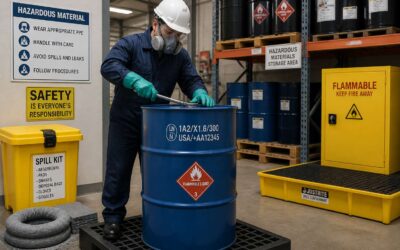
Storage demands the same respect. A container that spends months in a warehouse can develop micro leaks from floor contact or corrosion from forgotten moisture. Spill containment is not a theoretical exercise. It becomes real the second a seal pops.
- Position drip trays beneath every stored drum, not just those in active use.
- Rehearse incident response drills quarterly, including actual spill kit deployment.
- Mark the location of emergency absorbents so any worker can find them blindfolded.
The quietest part of the operation is the one that saves the facility when everything else fails.


0 Comments