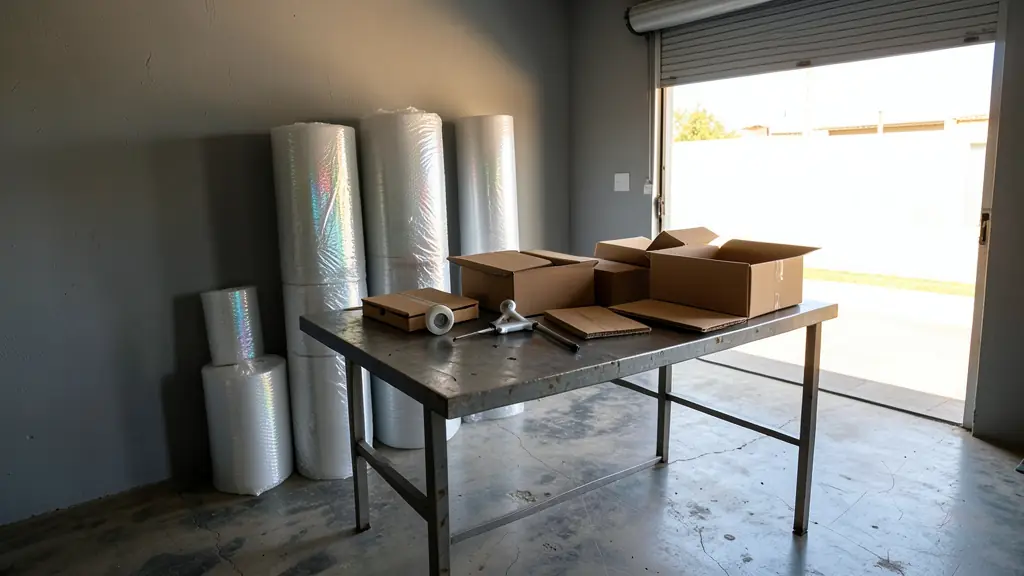
Wrapping an item in bubble wrap looks simple until you have to order a roll. The sheet has to go all the way around the item with an overlap and still be wide enough to fold over both ends, and every extra layer repeats that. This calculator works out the sheet for one item, the area and the metres off the roll, then scales it to your number of items with about 10% for waste. It also shows how many rolls you need and the wrap cost per item.
How the sheet size is worked out
Each item is wrapped like a parcel. The sheet goes around the girth, which is twice the width plus the height, with your overlap on top, and it must be wide enough to fold in over both ends, about a quarter of the width plus height at each end. For an item of 30 x 20 x 10 cm that is a sheet of 45 x 65 cm, or 0.29 m² a layer. The calculator turns the sheet to the direction that uses the least roll, adds about 10% for waste and multiplies by the layers. Two layers of that item need about 1 m off a 750 mm roll, so a 100 m roll wraps around 100 of them.
Small bubble, large bubble and layers
Small bubble (about 10 mm) is the everyday grade. It is soft, wraps tightly around edges and suits books, electronics, cosmetics and glassware. Large bubble (about 25 mm) holds more air and is used for heavy items, furniture corners and to fill voids in a box, but it is bulkier and does not wrap tightly. Light, fragile items such as glasses need two layers at least. Heavy or very fragile items often need three, with a snug box and no room to move. Bubbles face inward to the item for the best cushioning on a smooth surface. Wrap film is thin, so do not rely on it to take weight; it protects from knocks and scratches, not crushing.
Anti-static, bags and alternatives
- Anti-static (pink) bubble wrap carries a coating that reduces static build up. Use it for circuit boards, hard drives and sensitive electronics, and ask your supplier to confirm the grade.
- Bubble bags and bubble lined mailers save the wrapping time for repeat sizes. They suit small items sent by courier. See bubble wrap for rolls and bags.
- Paper is a plastic free option for wrapping and void fill. Crinkled kraft paper takes more volume than bubble for the same protection on fragile goods.
- Foam sheet and pouches grip better than bubble and suit polished surfaces and delicate finishes. Foam is usually dearer per item, so compare the cost per item with other protective packaging.
Frequently asked questions
How much bubble wrap do I need for one item?
Which roll width should I buy?
Do I need small or large bubble?
Are the prices exact?
More packaging tools
- Volumetric weightCourier volumetric and chargeable weight for one parcel or a whole shipmentTL-01
- Carton size and boardCarton volume, outside size, blank size, board area and weight for a slotted boxTL-02
- Cartons per palletCartons per layer and per pallet, load height, weight and pallets per containerTL-03
- Pallet wrap filmStretch film per pallet in metres, grams and rand, with rolls needed per monthTL-04
- Packaging tapeTape per box, boxes per roll, rolls per month and tape cost for I, L and H sealsTL-05
- Moving boxesHow many small, medium, large and wardrobe boxes, tape and paper for your moveTL-07
- Compare supplier quotesPut up to three quotes side by side: landed cost per unit, VAT and break-even quantityTL-08
- Film thickness converterConvert micron, gauge, mil and mm, then film weight, m² per kg and grams per bagTL-09
- Corrugated board guideFlute chart, box styles and a selector that suggests the right board for your loadTL-10
- Plastic recycling codesWhat resin codes 1 to 7 mean: uses, heat, food contact and recycling in South AfricaTL-11