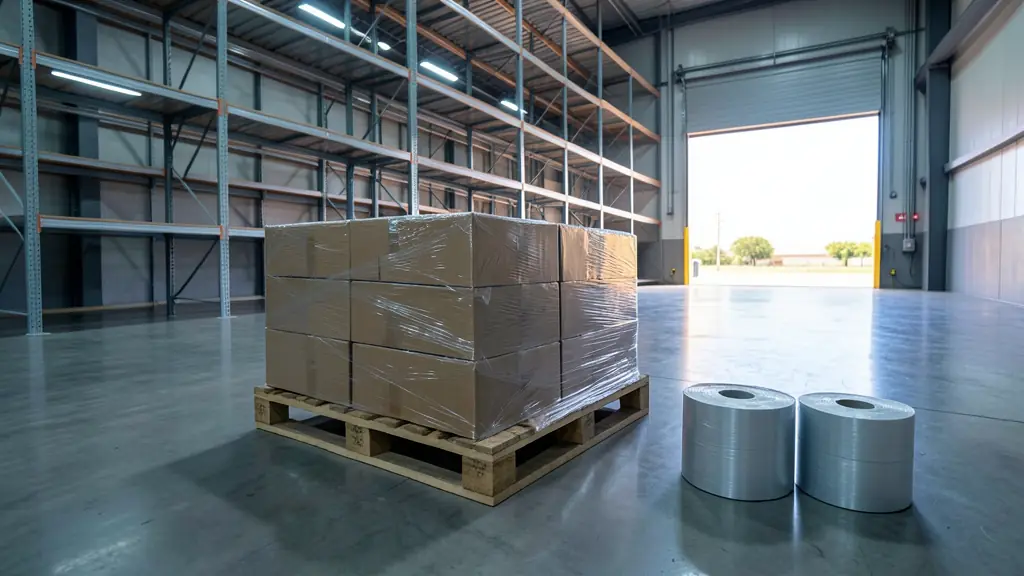
Stretch film is cheap per pallet but it adds up across hundreds of pallets a month, and most waste comes from wrapping too many turns with film that is barely stretched. This calculator counts the revolutions from your load height, film width and overlap, adds the extra wraps at the base and the top, then converts that into metres of film off the roll, grams, pallets per roll and cost. Compare hand wrapping with machine pre-stretch to see what the right film and equipment save you.
How the film per pallet is worked out
The wrapper climbs the load in a spiral. Each turn must overlap the one below, so with 500 mm film and 50% overlap it rises 250 mm a turn. The number of turns is the load height minus one film width, divided by that rise and rounded up, plus one for the first turn, plus your extra wraps at the base (to lock the pallet) and at the top (to hold the top layer). A 1,200 x 1,000 mm pallet is 4.4 m round, so 1,600 mm of load needs 11 turns, or 48.4 m of film on the pallet. Hand film stretched by 30% means 37.2 m comes off the roll, which is about 340 g of 20 micron film, or 8 pallets from a 300 m roll.
Pre-stretch is where the saving is
Pre-stretch is how far the film is pulled before it touches the load. Power pre-stretch on a wrapping machine typically runs from 150% to 300%, so each metre off the roll becomes 2.5 to 4 metres on the pallet. Hand wrapping rarely gets past 50%. With the same 11 turns, a machine at 200% would use only about 150 g per pallet, a little over half the film of the hand wrap, with a tighter hold. If you wrap more than about 20 pallets a day, a pallet wrapping machine is worth pricing. Machine rolls are long, often 1,500 m or more, and cost more per roll but far less per pallet.
Cast or blown, and how thick
Cast film is made by chilling the melt on rollers. It is clear, quiet to unwind and clings well, and it stretches evenly, so it is the usual choice for machines. Blown film is made as a bubble, so it is stiffer and tougher against puncture and holds a load harder after wrapping. It suits hand wrapping, sharp corners and heavy or uneven loads, but it is often a little hazier. Thickness runs from about 17 to 30 micron. Light, regular cartons usually wrap well in 17 to 20 micron, while heavier or sharp loads need 23 micron or more. Read more on the pallet wrap page, and use the pallet calculator to plan the load itself.
Containment, waste and what to check
- Anchor the load. Start with the film tied to the pallet, then wrap the base at least three times so the bottom layer cannot slide.
- Overlap enough. 50% gives a double layer. Less saves film but leaves weak spots that tear in transit.
- Do not over wrap. More turns will not fix a poorly stacked load. Square the load, add corner boards and a top sheet instead.
- Watch the tail. Cut the film clean and tuck the end in. Loose tails catch on forklifts.
- Weigh a wrapped pallet. Compare the real film use with the calculator for a few weeks. If it is far higher, check pre-stretch, overlap and who is wrapping.
Frequently asked questions
How much stretch film does one pallet need?
What is the difference between hand film and machine film?
Which film thickness should I choose?
Why does my wrapped load still move on the truck?
More packaging tools
- Volumetric weightCourier volumetric and chargeable weight for one parcel or a whole shipmentTL-01
- Carton size and boardCarton volume, outside size, blank size, board area and weight for a slotted boxTL-02
- Cartons per palletCartons per layer and per pallet, load height, weight and pallets per containerTL-03
- Packaging tapeTape per box, boxes per roll, rolls per month and tape cost for I, L and H sealsTL-05
- Bubble wrapSheet size, metres off the roll, rolls needed and bubble wrap cost per itemTL-06
- Moving boxesHow many small, medium, large and wardrobe boxes, tape and paper for your moveTL-07
- Compare supplier quotesPut up to three quotes side by side: landed cost per unit, VAT and break-even quantityTL-08
- Film thickness converterConvert micron, gauge, mil and mm, then film weight, m² per kg and grams per bagTL-09
- Corrugated board guideFlute chart, box styles and a selector that suggests the right board for your loadTL-10
- Plastic recycling codesWhat resin codes 1 to 7 mean: uses, heat, food contact and recycling in South AfricaTL-11