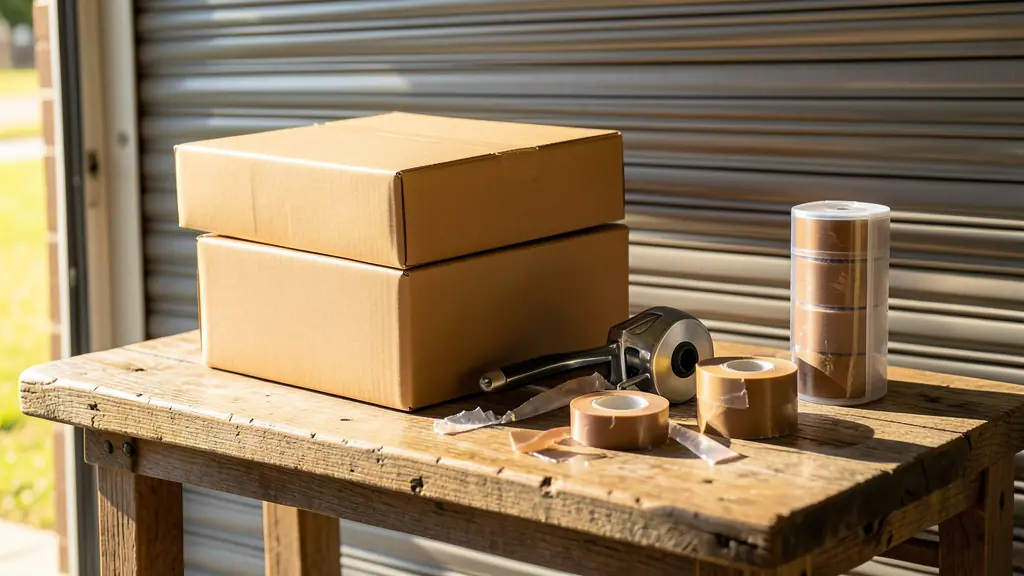
Tape is a small cost per box, but it adds up across thousands of cartons, and most packing benches use more than they need. This calculator works out the length of tape on one box from its size, the seal pattern and the overhang down each end. It then shows how many boxes a roll seals, how many rolls you will use in a month and the cost per box. Change the roll length or width to compare a hand roll with a machine roll.
How the tape length is worked out
The seam where the two top flaps meet runs along the longer side of the box. An I-seal is one strip along that seam plus the overhang down each end face. For a 400 x 300 x 300 mm box with 60 mm overhang, that is 400 + 60 + 60 = 520 mm for the top. Sealing the bottom as well doubles it to 1,040 mm, and about 5% on top allows for cuts and the tape that gets wasted at the start of a roll, which gives roughly 1.1 m a box. A 66 m roll then seals about 60 boxes. An H-seal adds a strip along each end seam and uses about two and a half times as much tape as an I-seal, so use it where it earns its keep.
Acrylic, hot melt or natural rubber
The adhesive matters more than the colour. Acrylic tape bonds slowly, ages well and keeps working in sun, heat and long storage, which suits stock that sits on a shelf. It is usually quiet to unwind and the best value for most shops. Hot melt (synthetic rubber) grabs at once and holds well on dusty or recycled board, so it suits fast packing lines, but it can yellow and let go in heat. Natural rubber is the most aggressive and works in cold stores and on rough surfaces, but it does not like long sun exposure. Film thickness is stated in micron: about 35 to 40 micron is light duty, 45 to 50 micron is the usual general purpose grade, and 55 micron and up suits heavy cartons. Ask your supplier for the adhesive type, as it is often not printed on the roll.
Cold, dust, tape guns and carton sealers
- Cold rooms and freezers. Standard acrylic gets stiff and lets go below about 5 degrees. Use a cold-store or natural rubber grade and apply it to dry, clean board.
- Dusty or recycled board. Dust and loose fibre weaken the bond. A tackier hot melt or rubber tape often holds where acrylic lifts, and a wipe along the seam helps.
- Tape guns. A hand dispenser suits up to a few hundred boxes a day. A steel body with a brake keeps the tape from flagging, and it gives a tidier, more even strip than hand cutting.
- Carton sealers. Above about 500 boxes a day, a sealer applies a clean I-seal in seconds and takes 1,000 m rolls. See packaging machines for options.
Printed tape and paper tape
Printed tape carries your logo or a warning such as "fragile", and it also shows when a box has been opened. Expect a minimum order of a few dozen rolls, and a per roll price roughly one and a half to three times that of plain tape. Paper (kraft) tape is the plastic free choice. It needs water or a self-adhesive backing, tears by hand and bonds into the board, so it is hard to peel off cleanly, which suits boxes that are meant to be tamper evident. Use the packaging tape page to get quotes for any of these.
Frequently asked questions
How much tape do I need to seal a box?
How long should the overhang be?
Is 48 mm or 72 mm tape better?
Are the prices in this calculator exact?
More packaging tools
- Volumetric weightCourier volumetric and chargeable weight for one parcel or a whole shipmentTL-01
- Carton size and boardCarton volume, outside size, blank size, board area and weight for a slotted boxTL-02
- Cartons per palletCartons per layer and per pallet, load height, weight and pallets per containerTL-03
- Pallet wrap filmStretch film per pallet in metres, grams and rand, with rolls needed per monthTL-04
- Bubble wrapSheet size, metres off the roll, rolls needed and bubble wrap cost per itemTL-06
- Moving boxesHow many small, medium, large and wardrobe boxes, tape and paper for your moveTL-07
- Compare supplier quotesPut up to three quotes side by side: landed cost per unit, VAT and break-even quantityTL-08
- Film thickness converterConvert micron, gauge, mil and mm, then film weight, m² per kg and grams per bagTL-09
- Corrugated board guideFlute chart, box styles and a selector that suggests the right board for your loadTL-10
- Plastic recycling codesWhat resin codes 1 to 7 mean: uses, heat, food contact and recycling in South AfricaTL-11